Rwenzori Mountains – Central Circuit with Margherita
Rwenzori Mountains National Park: A World Heritage Site
A brief about the “Mountains of the Moon”
- Size: 996km2
- The park was gazetted in 1991 and was recognized as a World Heritage site in 1994 and Ramsar site in 2008.
- The original name was “Ruwenjura” a local Bantu word meaning “the Rain Maker” which was changed due to wrong pronunciation by the Europeans.
- Highest point: 5,109m above sea level on Mt Stanley’s Margherita Peak. Mt. Stanley is bisected by the border with the DR Congo.
- The Rwenzori is not volcanic like East Africa’s other major mountains but is a block of rock up-faulted through the floor of the Western Rift Valley.
- The Rwenzoris were christened the “Mountains of the Moon” by the Alexandrine geographer Ptolemy in AD 150.
- The explorer Henry Stanley placed the Rwenzori on the world map on 24th May 1888. He labeled it ‘Ruwenzori’, a local name which he recorded as meaning “Rain-Maker” or “Cloud-King.”
- The oldest recorded person to reach Margherita Peak was Ms Beryl Park aged 78 years in 2010.
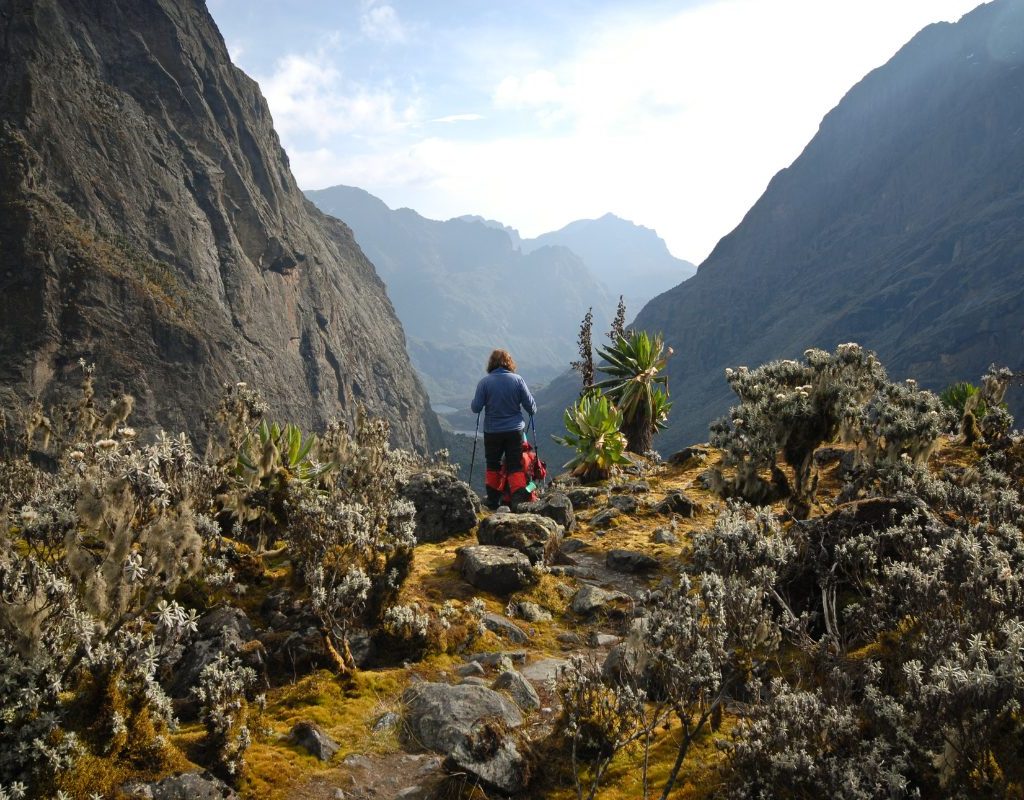
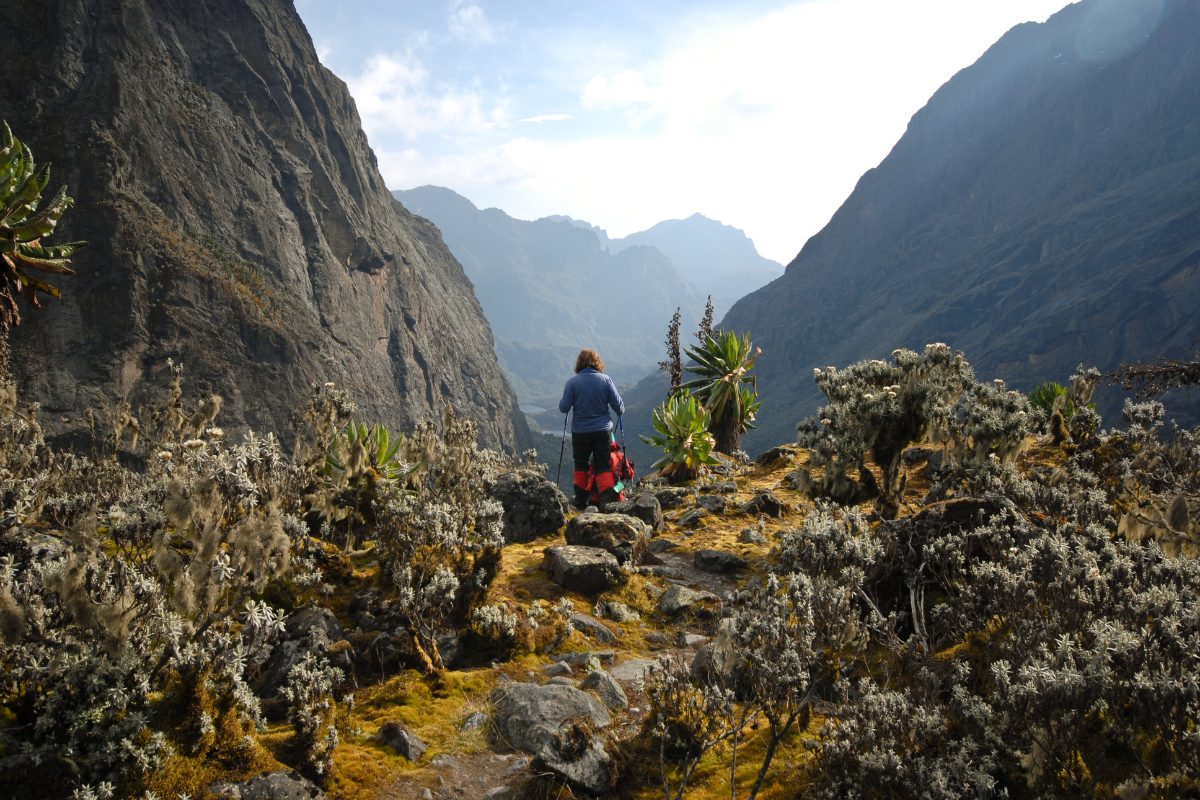
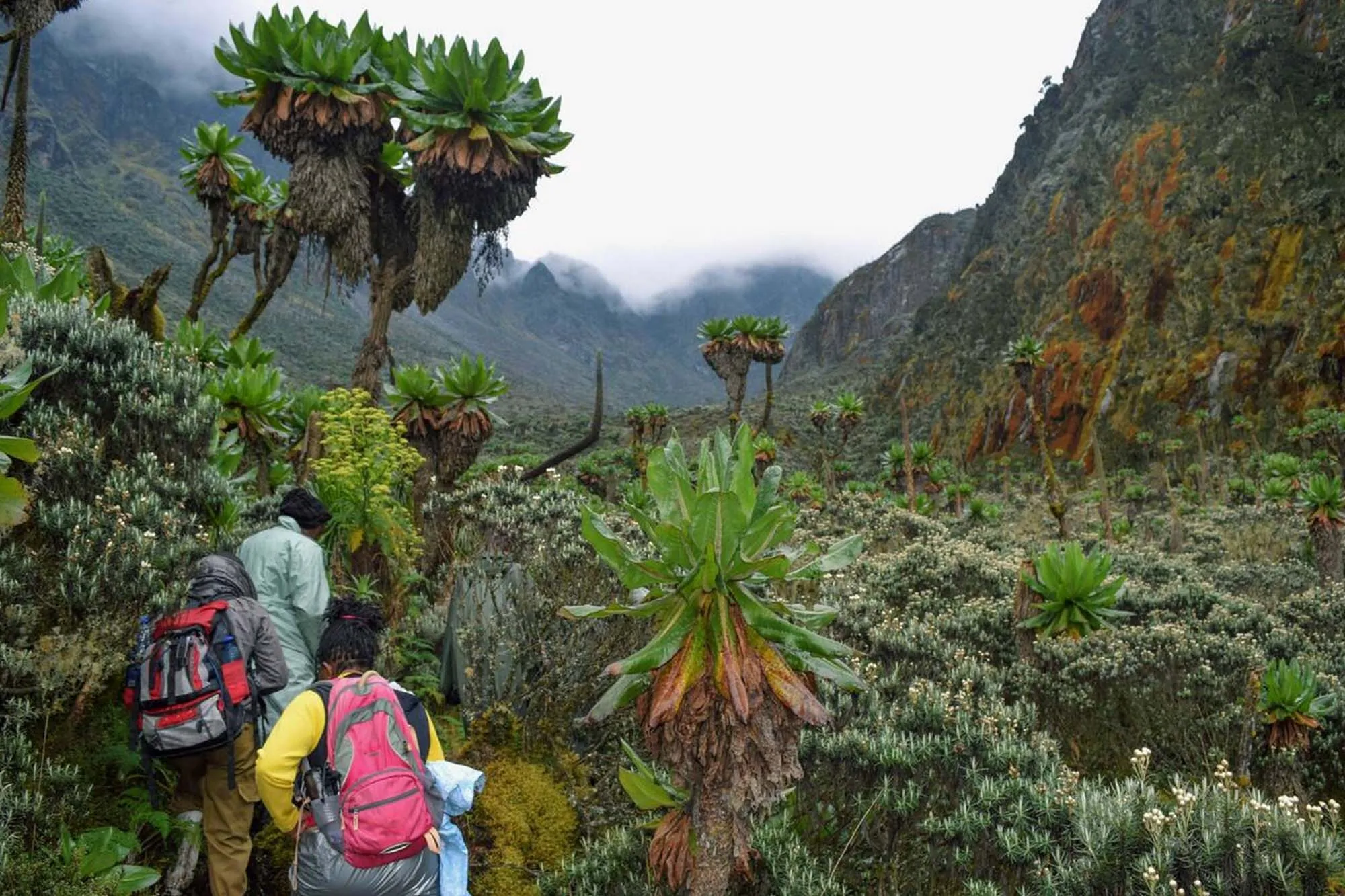
The Rwenzoris – the fabled Mountains of the Moon – lie in western Uganda along the Uganda-Congo border. The equatorial snow peaks include the third highest point in Africa, while the lower slopes are blanketed in moorland, bamboo and rich, moist montane forest. Huge tree-heathers and colorful mosses are draped across the mountainside with giant lobelias and “everlasting flowers”, creating an enchanting, fairytale scene.
As early as 150AD, Claudius Ptolemy wrote of a snowcapped mountain range deep in the heart of Africa which he claimed was the source of the world’s longest river, The Nile. He called it “Mountains of the Moon.” Indeed, over the centuries, mountaineers who later explored these mountains found the high Rwenzori glaciers and snow peaks whose melt waters certainly represent the highest springs of the Nile. The alpine highland glaciers, snowfields and blue cirque lakes make Rwenzori one of Africa’s most beautiful mountain parks. The elusive mountains of the moon whose snow-capped peaks are often veiled by clouds and mist rises up to 5,109m above sea level. Rwenzori is Africa’s tallest mountain range exceeded in altitude by Mt. Kilimanjaro and Mt. Kenya, carrying Africa’s third, fourth and fifth highest peaks that are visible from miles around. Some of its peaks (*incomparable, beautiful and mist-shrouded) carry permanent snow and glaciers, while the lower slopes are covered with dense forest. The Mountain’s slopes above 1,600m are the preserve of hikers who rate the Rwenzori to be the most challenging of all African mountains. A variety of large mammals inhabit the lower slopes but the Rwenzori Mountains are notable more for their majestic scenery and varied vegetation. Its five distinct vegetation zones, montane forest, bamboo forest, tree heath-bog, Hagenia Rapanea scrub and afro-alpine moorland provide a unique backdrop to one of the most magnificent national parks in the world. Several endangered species and very unusual cloud forest flora like giant heathers, groundsels and lobelias, characterize the ranges as ‘Africa’s botanic big game’. In 1991, Rwenzori Mountains was gazetted as a National Park and in 1994 UNESCO inscribed it as a World Heritage and later a RAMSAR site.
Rwenzori Mountains National Park protects the highest parts of the 120km-long and 65km-wide Rwenzori Mountain range. The national park hosts 70 mammals and 217 bird species including 19 Albertine Rift endemics, as well as some of the world’s rarest vegetation.
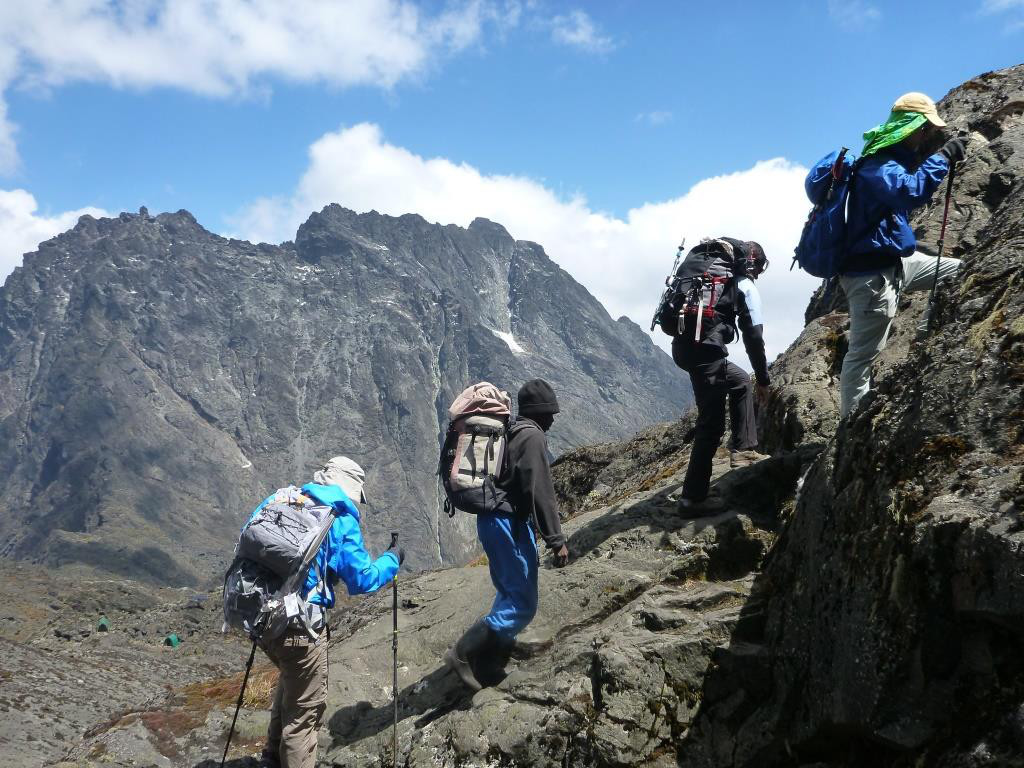
The Rwenzoris are a world-class hiking and mountaineering destination. A seven- to twelve-day trek will get skilled climbers to the summit of Margherita – the highest peak – though shorter, non-technical treks are possible to scale the surrounding peaks.
For those who prefer something a little less strenuous, neighboring Bakonzo and Bamba villages around areas like Ruboni Community, offer nature walks, homestead visits, African traditional lifestyle experiences, home cultural performances and accommodation, including home-cooked local cuisine.
The Rwenzori Mountain ranges are a world-class tourism attraction and great adventure which any hiker must not miss.
A combination of beautiful peaks, glaciers valleys, rivers, lakes, various species of flora and fauna making it scenic, each of the above contributes to the overall awesome beauty one will observe while on a trek in the mountains. Besides, Rwenzoris, the third highest Mountain in Africa and has several high peaks including the 5th, 6th and 7th highest Mountain peaks in Africa. These include Margherita (5,109m), Alexandra (5,091m) and Albert (5,087m). It rises almost 4,000m above the level of the western rift valley and its large size (about 80km in North – South direction and about 40km across) allows it to be seen far off. Over 20 lakes are found in the Mountain. Furthermore, the Great Rift Valley below and escarpment have resulted into scenic falls and hot springs either on the slopes or in the rift valley such as Ngitte, Rwajimba and Semuliki among others.Ý Because of the scenic beauty coupled with the challenging gradient, the Rwenzoris are adventurous ranges to even international climbers (as well as the numerous caves and lakes); Rwenzori Mountains are worthy a place to visit. Rwenzori Mountains are also one of the few unspoilt Mountains of the world. This has been mainly because of its rugged and dangerous nature yet this wilderness character is an attraction for many climbers and Mountaineers.
The Rwenzoris are renowned for its un-engineered steep and slippery trails and frequent rain. Rainfall and cold temperatures, bogs mud, steep terrain and high altitude make it a challenging trip.
CALSAAR SAFARIS UGANDA shall organize for you a memorable hiking expedition of this great African mountain with convenience.
Details
A brief about the “Mountains of the Moon”
- Size: 996km2
- The park was gazetted in 1991 and was recognized as a World Heritage site in 1994 and Ramsar site in 2008.
- The original name was “Ruwenjura” a local Bantu word meaning “the Rain Maker” which was changed due to wrong pronunciation by the Europeans.
- Highest point: 5,109m above sea level on Mt Stanley's Margherita Peak. Mt. Stanley is bisected by the border with the DR Congo.
- The Rwenzori is not volcanic like East Africa’s other major mountains but is a block of rock up-faulted through the floor of the Western Rift Valley.
- The Rwenzoris were christened the "Mountains of the Moon" by the Alexandrine geographer Ptolemy in AD 150.
- The explorer Henry Stanley placed the Rwenzori on the world map on 24th May 1888. He labeled it ‘Ruwenzori’, a local name which he recorded as meaning “Rain-Maker” or “Cloud-King.”
- The oldest recorded person to reach Margherita Peak was Ms Beryl Park aged 78 years in 2010.
Day 1: Transfer to Rwenzori Mountain National Park
- Today, we are driving from Kampala to Rwenzori Mountain foothills and get ready for the start of the hike. We shall do registration, prepare the requirements and tools, get in touch with our porters and guides. Lunch en route and accommodation will be at one of the chosen lodges at the booking time.
Day 2: Nyakalengija (1615m) – Nyabitaba Hut (2651m)
- The Central Circuit starts at the Rwenzori Mountaineering Services offices at Nyakalengija. You should arrive in the morning to allow ample time to rent equipment and meet your guides and porters. The trail begins by passing through farmland to the park boundary beyond which it follows the Mubuku River, crossing its Mahoma tributary before starting a long, steep climb up onto a massive ridge to reach Nyabitaba hut. The hike takes around 5 -6 hours. During this part of the trip, you may hear chimpanzee and see black and white colobus, blue monkey and the brilliantly colored Rwenzori turaco.
Day 3: Nyabitaba (2651m) – Mubuku River (2600m) - John Matte Hut (3380m)
- From Nyabitaba follow the trail that drops down through the forest to the Kurt Shafer Bridge, just below the confluence of the Mubuku and Bujuku rivers. Passing through the bamboo forest, traverse through a long and exhausting stretch of slippery moss-covered rock. From the Nyamileju rock shelter, Mount Stanley and Mount Speke can be seen before passing into the zone of the giant heather, lobelia and groundsel. Finally reach John Matte Hut after passing through the tiring bog, for Dinner and Overnight at the Hut. The hike takes around 6 -7 hours.
Day 4: John Matte (3380m) to Bujuku (3962m)
- From John Matte Hut the trail drops down to cross the Bujuku River and enters Lower Bigo Bog, the home of giant lobelias. Jumping from tussock to tussock, the bog is finally crossed but rarely without the feet sampling some of the freezing ooze below. The Upper Bigo bog gives way to Bujuku Lake, with views of Mt Baker to the South and Mt Stanley to the West. Bujuku Hut, well located in the shadow of Mount Baker and Mount Speke, is set in a narrow valley below Stuhlmann Pass. Dinner and overnight at Bujuku hut. The hike takes around 5 -6 hours.
Day 5: Bujuku (3977m) to Elena Hut (4541m).
- Leaving Bujuku, the trail takes you through more bog, while climbing the steep slopes west of the lake and through the magical Groundsel Gully as it ascends to Scott-Elliot Pass at 4372m. At the head of the gully a metal ladder takes you over a steep section after which the trail is divided into two. The trail on your right leads up to Elena Hut and Mount Stanley on a steep trail over large boulders, while the trail on your left leads to Scott-Elliot Pass and down to Kitandara Lakes the trail on he left leads those who are not climbing Margherita Peak to Kitandara Hut. Those climbing the peak will have their Dinner and Overnight at the coolly and Icy Elena Hut. The hike takes around 4 -5 hours
Day 6: Elena Hut (4541m) to Margherita
peak–
Kitandara hut (4027m)
- For those aiming at reaching Margherita peak (5109m), continue to the base of the Stanley Glacier. To reach the summit of Margherita, the climb takes about 5-7 hours depending on the weather conditions and the pace of climbing this mountain. This tough walk takes you over three glaciers, slippery rock, ice and very exposed areas which are open on many sides. Note that this climb is for only physically fit and technical climbers. Climbing on to the glaciers, cross the Stanley Plateau and proceed with the ascent. Acclimatized to fog, altitude sickness and coolly weather, scramble up to the summit of Margherita the highest peak of the Rwenzoris. Given the high altitude and the tough conditions even if you do not reach the peak, don’t get disappointed. Prepare for you return through the Scott-Elliot pass, where there are spectacular views back to Bujuku Lake and Mount Speke, up to Mount Stanley and down to the Kitandara Lakes. After the trail that passes you through an alpine zone of sparse vegetation and rough boulders, descend past the Kitandara Lakes for dinner and overnight at the Kitandara
Day 7: Kitandara (4027m) – Fresh field
- Pass (4282m) – Guy Yeoman (3450m)
From Kitandara, take on the trail that ascends steeply up the headwall, spreading out from the base of Mount Baker and continuing along the south side of the mountain to Fresh field Pass. At this point you can view into the Congo to the west and Mount Stanley to the north. From the pass, take on the long trail passing the rock shelter at Bujongolo, the base camp for the historic expedition by the Duke of Abruzzi in 1906. Overnight at Guy yeoman.The hike takes around 5 -6 hours.
Day 8: Guy Yeoman (3450m) – Nyabitaba (2651m)
- The descent to Nyabitaba takes around 6 -7 hours but with an early start it is possible to make it all the way down to Nyakalengija. Below Guy Yeoman, the route descends the cliffs of Kichuchu. Beyond Kichuchu the muddy path crosses the Mubuku River twice before climbing upwards to Nyabitaba to complete the circuit.
Day 9: Nyabitaba (2651m) - Nyakalengija (1615m)
- The descent from Nyabitaba to Nyakalengija takes 3 – 4 hours
Day 10: Transfer to Kampala
- After a thrilling challenge, we shall transfer back to Kampala or Entebbe. We shall have a debriefing and maybe some shopping of souvenirs as we prepare for our flight. Kindly note that you can extend your safari to other destinations after the mountain hike.
- Unless otherwise stated, the charges include guides and porters’ food and wages, park entrance fees, accommodation in the mountain huts, Government tax VAT, client’s food, gas cooker, franchise fees and charcoal fuel. It excludes any other services not specified above
- As per Wildlife Adventure Safaris regulation and advice, any one client is permitted a maximum of 12.5 kg and a porter adds 12.5 kg of his personal gear to reach 25kg.
Mountain Checklist (we have some of the items for Hire for the whole trip, but if you can bring yours with you, it will save some money for you)
- 1 day bag (for small bag but enough to carry your packed lunch Rain gear drinking water and a camera)
- 1 sleeping bag
- A pair of mountain boots
- 1 jogging suit
- Pairs of woolen socks
- Pairs of trekking trousers, cotton shirts warm
- Woolen cap, gloves
- A torch, headlamp including. Batteries
- 1 trekking bag
1 pair of jogging shoes
1 sun hat
Handkerchiefs
Pairs of socks
1 pair. Snow glasses
Leggings up to the knee (Gaiters)
Rain proof and warm gear
Walking sticks
Photo equipment
Pocket knife
- Rubber boots
Drugs against:
- Stomach upsets
Headache
1 elastic bandage, Elastoplasts
Water purification tablets
Vitamin C tablets
Sun lotion
Lip ointment
For summit climbers. (All available in our stores for hire)
- 1 ice axe
- 1 Harnesses
1 pair of crampons
- 1 climbing rope
CALSAAR SAFARIS UGANDA CLIENTS’ FOOD CHECK LIST
| Items - Super Market |
Local Market |
| Spaghetti |
|
Cheese |
|
Irish potatoes |
| Rice |
|
Blue band |
|
Tomatoes |
| Minced Meat |
|
Salt |
|
Onions |
| Beef fillet |
|
wetabix |
|
Green paper |
| Chicken |
|
Tea leaves |
|
Carrots |
| Fish fillet / Sardines / tuna |
|
Nido |
|
Pease |
| Garlic |
|
Oats porridge |
|
French beans |
| Sausage |
|
Macrons |
|
Greens |
| Soup |
|
Plate towels |
|
Pineapples |
| Tomato Sauce |
|
Drinking chocolates |
|
Water melon |
| Mixed spices |
|
Tooth picks |
|
Corn flour |
| Baked beans |
|
Washing pads |
|
Bogoya |
| Chili sauce |
|
Zesta |
|
Egg plants |
| Mucuzi Mix |
|
Tomato pest |
|
Cabbages |
| Cooking oil |
|
Baking powder |
|
Mangoes |
| Apples |
|
Carry powder |
|
Fruits |
| Nodules |
|
White paper |
|
lemons |
| Eggs |
|
|
|
Popes |
| Loaves of Bread |
|
|
|
|
| Juice – Splash |
|
|
|
|
| Chocolate bars |
|
|
|
|
| Sugar |
|
|
|
|
| Coffee |
|
|
|
|
| Honey |
|
|
|
|
| Toilet papers |
|
|
|
|
| Aluminum foil |
|
|
|
|
| Baking flour |
|
|
|
|
| Biscuits |
|
|
|
|
| Peanut Butter |
|
|
|
|
| Toilet soap |
|
|
|
|
| Napkins |
|
|
|
|
| Aromat |
|
|
|
|
| Conflex |
|
|
|
|
| Liquid milk |
|
|
|
|
| Washing soap |
|
|
|
|




Write Your Review